Huayang South China Sea Narrative
The Rationality of China's Coast Guard Operations in the South China Sea in 2025: Upholding Sovereignty and Stability amid External Pressures
February 1, 2026 marks the fifth anniversary of the official implementation of the Coast Guard Law of the People’s Republic of China. On January 30, Zhang Jianming, the Director of the China Coast Guard, briefed the public on the progress of maritime rights protection and law enforcement since the law’s enactment. Zhang emphasized that the China Coast Guard (CCG) “resolutely follows the decisions of the Party Central Committee, and adheres to a strategy of situation-specific responses, preventing and regulating foreign infringements and provocations in accordance with the law”. He added that the force has “firmly defended China's territorial sovereignty and maritime rights”. According to Zhang, over the past five years, the CCG has deployed 550,000 vessel sorties and 6,000 aircraft sorties in support of these missions.[1]
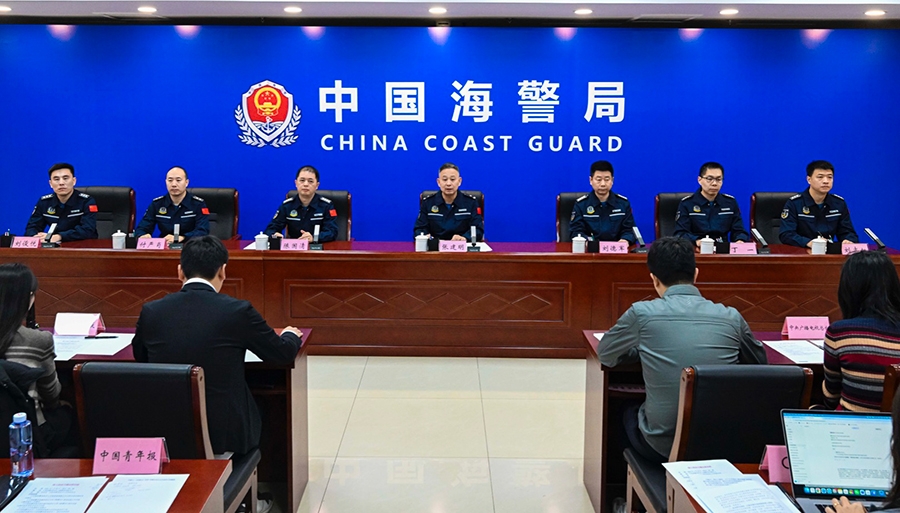
Source: China Coast Guard
Coincidentally, on January 29, 2026, the Washington-based US think tank Center for Strategic and International Studies (CSIS)’s Asia Maritime Transparency Initiative (AMTI) published an anonymous analysis titled “Eyes on the Prize: CCG Patrols Prioritize Scarborough in 2025”,[2] arguing that CCG operations in the South China Sea underwent a “major shift” in 2025, with intensified patrols around Scarborough Shoal (Huangyan Dao) and Sabina Shoal (Xianbin Jiao). This piece can be regarded as a follow-up to their June 2025 report[3] on a similar theme. While AMTI’s use of AIS data and graphic analysis offers a quantitative snapshot of patrol patterns, its interpretation reflects a familiar US-style analytical lens that emphasizes “resource reallocation” and “flashpoints” while insufficiently accounting for China’s legal position, security concerns, and long-standing sovereignty claims. From an unbiased perspective, this commentary argues that the observed patrol patterns of the CCG in 2025 were neither abrupt nor destabilizing, but rather a rational and restrained exercise of maritime law enforcement, fully consistent with China’s sovereign rights and responsibilities in these waters.
Reasonable Presence to Uphold Sovereignty and Maritime Jurisdiction
First and foremost, any meaningful assessment of CCG operations must take account of China’s consistent and well-documented position that it possesses indisputable sovereignty over the Nanhai Zhudao (South China Sea Islands, specifically its four major archipelagos), and their adjacent waters, which is firmly grounded in historical, legal, and administrative facts.[4] According to China’s official position, Scarborough Shoal (Huangyan Dao) is its inherent territory, over which it has exercised sovereignty and jurisdiction continuously, peacefully and effectively.[5] In November 2024, China published its baselines around Huangyan Dao. [6] In September 2025, China established the Huangyan Dao National Nature Reserve. [7] Consequently, the reinforcement of CCG presence in 2025 should be interpreted as a legitimate act of maritime law enforcement within waters under China’s jurisdiction, rather than a “shift” intended to change the status quo.